
Types of Garden Fences: Which One Is Right for You?
Pick the fence for the job — and if the job is deer, height is the whole game
There is no single best garden fence. Looks, privacy, and wildlife exclusion are three different jobs, and very few fences do all three well. Name the one that matters most and the rest of the decision gets a lot simpler.
- Start with the one job the fence has to do. A tidy border, privacy from neighbors, keeping the dog in, or keeping deer out are separate problems with separate answers.
- For deer, plan on 7 to 8 feet. Below that range a fence is a boundary, not a barrier — deer clear shorter fences without breaking stride.
- Polypropylene mesh and welded wire are the two materials built for exclusion. Poly mesh is light, nearly invisible, and DIY-friendly; welded wire is rigid and permanent for heavy deer pressure.
- Picket, lattice, split-rail, and standard vinyl are decorative. They mark a line and look good doing it, but they will not keep deer out at their usual heights.
- Price the fence in years, not at checkout. Wood needs sealing and staining; vinyl, metal, and poly ask for far less. Check local and HOA rules before you buy materials.
Height guidance follows Penn State Extension recommendations for deer exclusion fencing.
There’s no single “best” garden fence. What works for your yard depends on what you’re protecting, what you’re protecting it from, and what you want your finished yard to look like.
For instance, a low picket fence around a flower bed and an 8-foot barrier serve two completely different purposes. While the picket fence may be aesthetically pleasing, it definitely couldn’t hold back a herd of hungry deer. When looking for a garden fence, some folks just want curb appeal or a tidy edge on the yard. Plenty more want to stop deer, rabbits, and everything else from treating a vegetable patch like an open buffet.
That said, if you’re shopping for a garden fence for your outdoor space, use this guide to understand what to look for and which option will best serve your garden and your budget.
What to Consider Before Choosing a Garden Fence
Before you really start comparing materials and styles, pin down the one job your fence absolutely has to do. A fence that looks lovely around a front flower bed can be useless against a deer that clears 7 feet without breaking stride. Here are a few things to consider:
- Your goals. Privacy from the neighbors, a tidy border, a way to keep the dog from bolting, a wall against deer and rabbits — these are all different jobs, and few fences do all of them well. Name the one that matters most, and the rest of the decision gets a lot simpler.
- Long-term costs: The sticker price can lie. A cheap fence that requires re-staining every couple of years – or replacing in five – often costs more in the end than a sturdier one that requires minimal maintenance. Think in years, not dollars at checkout.
- Local rules and your HOA. Your town or homeowners association may have opinions about how tall the fence can be, what it’s made of, even what color it is, and how far back it sits from the property line. Five minutes spent checking now beats ripping out a finished fence later.
- Maintenance. Ask yourself what upkeep you’re willing to handle. On one end of the spectrum, you’ll need to seal, stain, and paint wood. On the other side of the spectrum, you won’t have to perform any maintenance for vinyl and metal fencing. It ultimately depends on your preferences and schedule.
- Your ground. Slope, soil, drainage, sunlight, and nearby trees all shape what’s practical.
- Your aesthetic preferences. Your fence is part of the view. Decide whether you want it to stand out as a feature, support climbing plants, or blend into the background.
The fence that’s right for you will depend on one or more of the aforementioned factors. Keep this in mind as you’re shopping around for garden fences.
Side by side
Garden fence types compared
Every option balances looks, upkeep, cost, and protection differently. Here is how the common garden fence materials stack up — and which ones actually stop a deer.
Garden fence types compared
Every option balances looks, upkeep, cost, and protection differently. Here is how the common garden fence materials stack up — and which ones actually stop a deer.
| Fence type | Typical height | Maintenance | Upfront cost | Stops deer? |
|---|---|---|---|---|
| Wood (panel or board) Versatile, paintable, board-by-board repairs | 4–6 ft | High — seal, stain, repaint | $$$ | No |
| Vinyl Picket, rail, lattice-top, and privacy styles | 4–6 ft | Low — rinse and go | $$$ | No |
| Picket Spaced vertical boards on horizontal rails | 3–4 ft | Medium to high if wood | $$$ | No |
| Lattice Garden screen and climbing-plant support | 3–6 ft | Medium | $$$ | No |
| Ornamental metal Wrought iron, steel, aluminum | 4–6 ft | Low | $$$ | No |
| Privacy fence Solid panels in wood, vinyl, composite, or metal | 6–8 ft | Varies by material | $$$ | Only if tall |
| Garden netting & plant guards Spot protection for beds, shrubs, young trees | Per plant | Low, but check often | $$$ | Spot only |
| Welded wire Rigid grid; gauge and mesh sized to the critter | 7–8 ft | Low | $$$ | Yes |
| Polypropylene deer fence Nearly invisible mesh, no concrete, DIY-friendly | 7–8 ft | Low — rust and rot proof | $$$ | Yes |
Cost is relative, not quoted. Dollar signs compare materials against each other, not a real budget. Final price depends on linear footage, height, posts, gates, and whether you install it yourself. See the full deer fence cost breakdown.
Types of Garden Fences
Garden fences come in many different materials, heights, and styles, and each one strikes a different balance among looks, upkeep, cost, and protection. Here’s how the common options stack up.
Wood Fences
When you think of a classic fence, wood is what usually comes to mind. Its biggest strength as a building material is its versatility. You can cut and shape it however you like and paint or stain it to match your shed, deck, or the rest of your landscape. It’s often easy to find, and when a single board takes damage, you can usually swap that one out instead of rebuilding a whole section.
The only catch is maintenance. Wood is at the mercy of the elements — moisture, insects, rot, warping, and splintering can all affect its functionality and appearance. To avoid these issues, you’ll need to regularly seal, stain, and repaint the material.
While shorter 3- to 4- foot wooden split-rail and picket fences may work for general livestock containment, they are not an effective deer barrier at standard height. These fences can mark a boundary, but deer can easily jump over them.
Vinyl Fences
Vinyl gives you the look of painted wood without the weekend spent repainting. It comes in picket, rail, lattice-top, and solid privacy styles. It skips the staining and painting entirely and shrugs off moisture, rot, and insects. A rinse with mild soap and clean water usually keeps it looking sharp, and a well-installed fence can last a long time.
You will, however, see yourself sacrificing a few things in terms of maintenance and price when it comes to this type of fencing. Vinyl usually costs more upfront than basic wood, and it can crack or turn brittle in a hard freeze. Damaged panels are not always easy to fix, and you won’t find the range of colors and custom looks you get from real wood.
Much like wood, standard vinyl panels are too short to keep deer out. So, for anyone fencing because of deer in the first place, vinyl lands in the same place as wood - aesthetically pleasing and low effort, but also a foot or two short of really being useful.
Metal Fences
As an incredibly versatile material, metal covers a lot of ground, from practical wire mesh to ornamental aluminum and wrought iron. How well it performs depends heavily on the metal, gauge, mesh size, coating, and overall design.
Welded wire is just what it sounds like: horizontal and vertical wires joined at every intersection, creating a rigid grid that holds its shape under pressure. This is serious wildlife-exclusion material.
When choosing welded wire metal fencing, you have to decide on a gauge and mesh opening. The right choice will ultimately come down to which critters you’re trying to keep out. Smaller openings stop smaller animals like rabbits and rodents, while heavier gauges withstand bigger, pushier wildlife. Height matters just as much, since even a tough metal fence fails if it’s short enough for a deer to clear.
The most common choices for metal fencing are:
- Wrought iron
- Steel
- Aluminum
- Ornamental metal
While wrought iron, steel, and aluminum are more durable, ornamental iron is low-maintenance. It can also get expensive, and often needs professional installation. Wide gaps between bars can also be an open invitation for rabbits and other small animals to enter your garden, and unless paired with a second barrier, it won’t reliably stop deer.
Picket Fences
Picket fences are the evenly spaced vertical boards you picture around a cottage garden, usually 3-4 feet tall and tied together by horizontal rails.
They draw a clean boundary without walling off the view, and basic wood pickets can be pretty affordable. However, they don’t keep out much. Small animals can easily slip beneath pickets, and the low height is certainly no obstacle to a deer. Think of picket fencing as decorative or organizational features in your yard, not as wildlife barriers.
Lattice Fences
Lattice panels use that familiar crisscross pattern, and they’re popular as garden screens. They make great dividers and supports for climbing plants. Vines and flowers happily climb them, creating a living screen that provides some privacy. You can even mount a lattice on top of a solid fence to add apparent height without the heavy, boxed-in feeling.
For keeping animals out, though, lattice is a non-starter. The openings let wildlife through, over, and around it, and it’s definitely less sturdy than most solid wood, vinyl, or metal designs.
Privacy Fences
Privacy fences use solid panels or tightly spaced boards to block views from both directions. They are usually 6 to 8 feet tall and come in wood, vinyl, composite, or metal.
The main draw is seclusion. A privacy fence makes a backyard feel like its own space. It can also provide some reprieve from the wind. Because a tall, solid panel hides the landing spot on the other side, it can also discourage deer, which don’t like jumping toward ground they can’t see.
The trade-offs are real, though. Privacy fencing can be pricey and may need a permit. Solid panels block sunlight and airflow, which nearby plants may not love, and a tall fence can make a small garden feel closed in. Your neighbor may also feel crowded on their property or be unable to see much else. Wood versions need ongoing upkeep; vinyl and composite need less.
This is the right pick for backyards where privacy is the main goal and turning deer away is a welcome bonus.
Polypropylene Deer Fencing
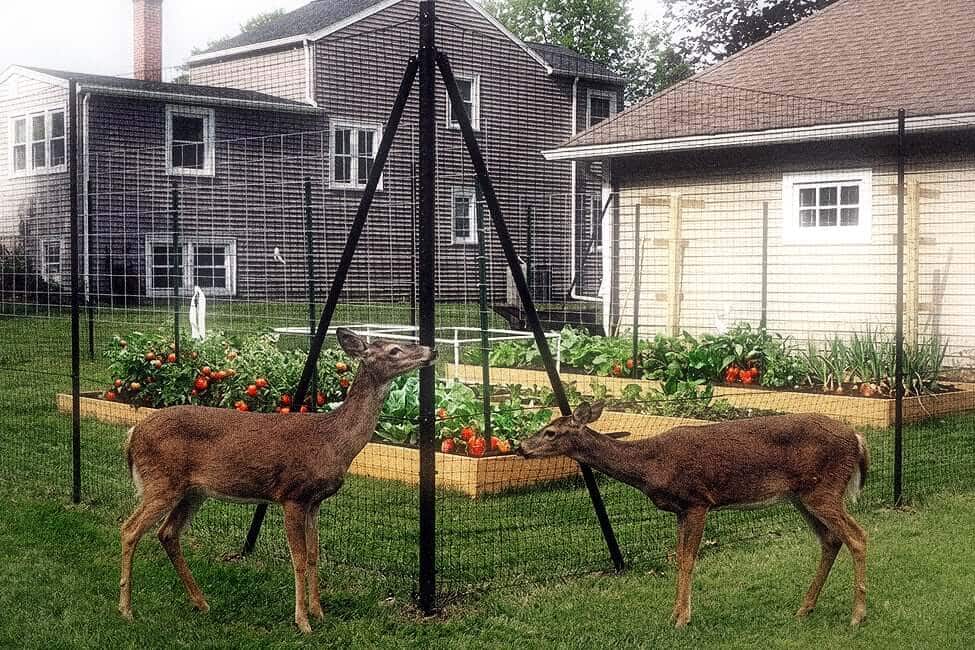
Polypropylene deer fencing is the one type that actually keeps deer out. It’s built for providing a hard perimeter around the vegetable gardens, flower beds, orchards, and landscaping.
The fence is a strong, lightweight plastic mesh, usually installed at a height of 7 to 8 feet, so deer can’t clear it. This design was created with deer behavior in mind, too, since height, visibility, landing room, and how deep the barrier appears all factor into whether a deer even bothers trying.
The black mesh is virtually invisible from a few feet away, so it blends into wooded edges and garden backdrops rather than dominating the view. It won’t rust or rot; the lightweight rolls make it one of the friendlier materials for a DIY install – no concrete required – and it’s a humane, non-lethal way to stop the damage without relying on repellents or scare tactics.
Despite its practical benefits, some HOAs with strict “traditional materials” rules won’t allow it, and you have to install it right with proper tension, solid support posts, a secure ground line, and real gates for access.
Garden Netting and Individual Plant Protectors
Not every garden needs a full perimeter fence. Garden netting, tree guards, and plant cages give you a targeted way to protect smaller areas of your yard. Wrap them around young trees, shrubs, raised beds, or a few prized plants. They’re usually affordable, flexible, and easy to move as plants grow or your yard layout changes.
The only limit is scale. Protecting plants one by one is incredibly tedious across a large garden, and each barrier needs an occasional check to ensure it hasn’t shifted, been torn, or started choking off growing plants. Spot protection like this is handy, but it won’t replace a secure perimeter fence when deer or other wildlife regularly come through.
How tall does a garden fence have to be to stop a deer?
Deer clear most residential fences without slowing down. Only fencing built in the 7 to 8 foot range reliably convinces them not to try.
7 ft is the line — deer clear anything shorter. The tinted band at the right of each bar is the 7–8 ft exclusion range.
Each bar spans the typical height range; the pale cap is the upper end.
Height only works when the rest of the fence does. Plan on solid posts, proper tension, a secure ground line, and real gates — a tall fence still fails at its weakest point.
Heights shown are typical residential ranges. The 7–8 ft exclusion range follows Penn State Extension guidance for deer fencing.
Which Type of Garden Fence is Best for Keeping Deer Out?
The best deer fence is the one designed around how deer actually behave, not just how it looks. A fence can look like a perfectly respectable boundary and still amount to little more than a polite suggestion for a determined deer.
For dependable deer exclusion, polypropylene mesh and welded wire lead the pack. Experts, such as those at Penn State Extension, recommend using fencing that is around 7 to 8 feet tall when picking fencing. This range is tall enough that deer choose not to jump. From there, the right material depends on your property:
- Polypropylene mesh is lightweight, nearly invisible, rust-proof, and DIY-friendly – a great fit for most home gardens.
- Welded wire is more rigid and permanent, a better match for heavy wildlife pressure or a barrier you want to set and forget.
- Solid privacy fencing can deter deer if it’s tall enough, but it costs more and sacrifices the open feel a dedicated deer fence maintains.
- Picket, lattice, split-rail, and short vinyl simply aren’t built for the job.
A fence works even better when paired with good garden habits. Planting less-tempting greenery around the edges can ease browsing pressure. However, deer tastes shift depending on what else is on the menu. Healthy soil, smart plant choices, less waste, and a durable barrier together create a garden that largely protects itself.
Choose Deer Fencing for Better Garden Coverage
There’s a garden fence for nearly every yard and goal.
But the moment wildlife protection enters the picture, height and material stop being the style choices and become the whole ballgame. A fence has to be built for the animals it’s meant to keep out.
That’s the part we understand completely. Not sure where to start? Talk to a DeerBusters customer support representative at 888-422-3337 for a free quote, or request a sample to feel the mesh strength yourself! Most folks have their fence up in a single weekend.
FAQs
What Is the Best Type of Garden Fence?
It really depends on the job. Wood, vinyl, picket, and lattice fences win on looks, privacy, and clean garden borders. Polypropylene deer fencing and welded-wire fencing are the stronger options for wildlife exclusion. No single material is right for every yard, so weigh the animals you need to deter, the privacy you want, your local rules, the upkeep you’ll tolerate, your budget, and the look you’re after.
What Type of Garden Fence Is Best for Keeping Deer Out?
Polypropylene mesh deer fencing and welded wire fencing are among the most effective options. Aim for 7 to 8 feet of height and an installation with no gaps or weak points. Standard picket, lattice, split-rail, and short vinyl fences won’t reliably keep deer out, no matter what they’re made of.
How Tall Should a Garden Fence Be to Keep Out Deer?
A garden fence should generally be at least 7 to 8 feet tall to deter deer reliably. Shorter barriers may not be sufficient, particularly in areas with heavy deer pressure or where appealing food is visible inside the garden. Height is the single most important element of a deer fence, but it only works when paired with strong posts, proper tension, a secure ground line, and protected entry points.
What is the Most Low-Maintenance Garden Fence?
Vinyl and metal are usually the easiest to live with. Vinyl never needs painting or staining and resists rot and insects, while galvanized or coated metal shrugs off corrosion for years. Polypropylene fencing is also rust- and rot-proof, though it’s worth periodically checking for loose or damaged sections. Wood asks for the most attention - regular painting or staining, plus the occasional fight with rot, cracks, or warped boards.
Do I Need a Permit to Install a Garden Fence?
It varies by town and city. Local governments and HOAs may regulate fence height, materials, placement, color, and distance from property lines, sidewalks, or easements. Check your building or zoning department and review any HOA rules before you buy materials or start digging. Expect stricter requirements for tall privacy fences and deer fences than for short decorative borders.
What is the Cheapest Garden Fence Option?
Basic wood picket fencing and polypropylene mesh netting often have the lowest upfront cost, but the cheapest choice depends on the area size, the height you need, the posts and gates, and whether you hire out the labor. Don’t stop at the purchase price, either. Wood may need regular sealing, painting, repairs, and eventual board replacement, while vinyl and metal usually cost more upfront but require far less over time. Compare the full lifetime cost, not just the receipt.